Generation Nope & the Gender Gap
A weekly post in which I share (some of) the most thought-provoking content I read this week(ish), which I am too lazy to write full blog posts about.
Jan 22

A weekly post in which I share (some of) the most thought-provoking content I read this week(ish), which I am too lazy to write full blog posts about.
At a recent author’s talk at the University of Toronto, Joshua Gans opened discussion about his latest book ‘Disruption Dilemma’ by observing:
“People now want to be called disruptive, even when what they are doing is not, and that is a problem.”
He’s right, of course. If I have to listen to one more person tell me that their business idea is ”like Uber, but for X” and then proceed to explain something that is completely and entirely un-Uberesque, I am going to start carrying an airhorn.
“It’s like Uber, but for pet foo-MEEEEEEHHHHHHHHHHHHHHHHHHHHHH!!!!!!!!!
Happy Easter (or long weekend) to you! You can find me guest-posting at the EOList this week as part of a great Mentorship Month line-up. I got a little bit ranty about ‘millennials’ and mentorship. Check it out!
Image credit: Faye Cornish
What a whirlwind at the 2015 HRPA Annual Conference this week! On day one, following three keynotes, 2 sessions, lots of coffee, and two after-parties later, I arrived home with a brain full of ideas and an iPhone full of notes. Here’s my first post from this week’s HRPA Annual Conference 2015:
Why Your Organization Needs More Rebels, Heretics, and Weirdos
Take a second and think about the best team that you have ever been part of. What made the team great? What did it feel like to be part of it? How did the team members interact with one another?
If the team you’re thinking of was the picture of harmony and cooperation, it might be worth questioning your rose-coloured recollections of just how great it actually was. In the session “When Getting Along Doesn’t Equal Results” Nicole Bendaly notes that while harmony and cohesiveness often figure into our individual visions of an ideal team, these qualities can often mask a disconnect between what a team is doing and why they are doing it (the connection to organizational results). Read more
Note: This post was my contribution to the crowd-sourced ebook This Time It’s Personnel: Humane Resourced 2. The brainchild of David D’Souza, HR pro, fellow contrarian, and spectacular blogger at 101 Half Connected Things, all proceeds from the sale of this ebook go to charities collectively selected by the many talented and creative authors. I am massively enjoying reading the varied viewpoints it contains, and have had more than a few great ideas while absorbing my fellow authors’ wisdom – I very much recommend it (and it’s less than $5).
HR: Organizational Cheerleader or Agony Aunt?
If an Anthropologist were trying to conduct ethnographic research on the tribe known as ‘HR professionals’, HR blogs would offer a rich source of data. I imagine them hunched over a laptop reading, their notebooks filled with scribbles:
“Members of the tribe seem preoccupied with questions of collective purpose and meaning, resulting in a plurality of contradictory identities.”
Hello there! Season’s greetings to you. It’s no secret that I’ve taken a significant break from blogging here at Talent Vanguard in the past several months. Life got pretty busy in 2014 and I suddenly found myself chairing a committee which runs the largest mentorship program for HR professionals in Ontario, planning a wedding, painting a house, and managing a busy job. These are all wonderful things that I am immensely grateful for, but over the summer my ‘overwhelmometer’ redlined and something had to give.
Anyway, I’m writing this because I’m back! I’ll be live blogging the HRPA’s Annual Conference in January over at LiveHR, and I am determined to return to a regular blogging schedule here at Talent Vanguard in 2015. Ahead of that please check out my pre-conference post “An Insider’s Guide to Selecting Your Conference Sessions” over at LiveHR where I offer some sage advice (if I do say so myself) on the art and science of selecting one’s conference sessions – a task that anyone who has attended an HR conference will know can make or break your conference experience.
For anyone attending the conference here in Toronto, I can’t wait to see you. May 2015 bring great things for us all.
P.S. It feels so good to be about to hit Publish in WordPress right now 🙂 I missed this…
Those of us embroiled in the ‘war for talent’ often fail to appreciate that this ‘talent’ is made up of individuals fighting their own war for the job they want, or even just a foot in the door.
This is the unique ugliness of our modern day labour market, in which we are plagued by both talent shortages as well as un- and under-employment. And those on the front line feel it. Recent grads beg to be given a chance to gain the experience required to get the ‘entry-level’ job that requires experience. Those seeking to join a desirable company find that personal branding and networking is a full-time, 40 hour per week job in and of itself, with limited returns. The ‘hidden job market’ taunts all. It is an arms race out there, where any little edge can make the difference.
Which is why we shouldn’t be surprised to see the latest effort to exploit that desperation, a service calling itself ‘Good Golem’. Good Golem (Toronto based – don’t we have so much to proud of lately…sigh) bills itself as “your portal to the hidden job market” and it is a very different kind of job board. It provides the platform for an employee leaving a job to post details about the role (industry, pay, duties) and to name their price to assist a prospective employee to take their place – that assistance can consist of anything from putting in a good word to the boss, to acting as a formal reference and coaching someone for the interview. Payment is made only if the job seeker is successful at securing the job. Read more
This week, I’m interviewing Chris Taylor, writer, entrepreneur, and speaker, about his first book Beyond the Picket Fence, now available for pre-order. I was intrigued about the message of Chris’s book to live a deliberate life and wanted to know more about what this means for employees and employers, and Chris did not disappoint. I think that his message captures the mindset that many of us (regardless of generation) are drawn to in light of the changing dynamics of our economy and the evolution of the traditional ’psychological contract’ we enter into with our employers. Employees and employers both stand to gain by considering his thesis. I caught up with Chris in Spain via e-mail.
Thanks Jane. It’s definitely a different experience, but I’m enjoying having a message to share that I feel so strongly about. I always thought the best interviews I’ve hosted were with people who were passionate about their material, so I’m just hoping that comes through now that I’m on the other side of the proverbial mic!
An explicit focus in almost every area of HR is getting, developing, growing, and keeping top performers. The cream of the crop, the engaged, motivated and committed super star, showering discretionary effort wherever they go like flower petals.
And yet, we accept that performance distribution will look like this:
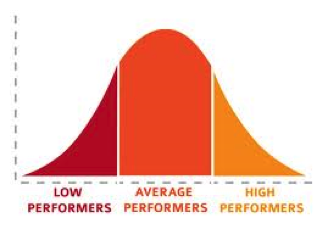
Or, if you agree with Josh Bersin, like this:

“An office is a place to live life to the fullest, to the max. An office is a place where dreams come true.” – Michael Scott, Dunder Mifflin
Have you noticed how organizations are no longer content with simply having engaged employees? Now they must also be happy. Why? In part because research claims to show that happy employees are more productive and create more value for their organizations.
Ah, say the social science majors, welcome to our world, where proving causation (rather than just correlation) is not such an easy thing to do. In fact, as reported in a recent article from Inc, competing research shows that happiness may in fact be a bi-product of focus and productivity, not the other way around. Read more


 Talent Vanguard